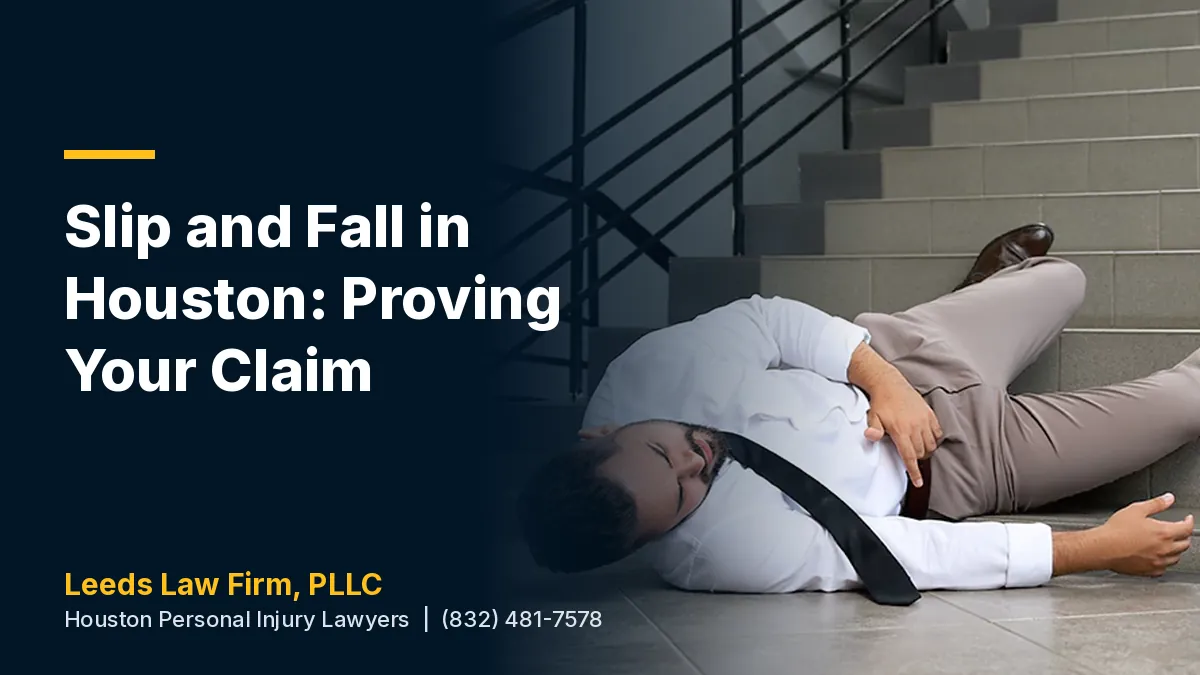
Short answer: In Texas, a store or property owner isn't automatically responsible because you fell. As a customer or tenant, you generally must prove the owner knew or should have known about the dangerous condition, that it posed an unreasonable risk, that the owner didn't use reasonable care to fix it or warn you, and that it caused your injury. Report the fall, photograph the hazard, ask for the video, and see a doctor. Most claims must be filed within two years, and falls on government property have much shorter notice deadlines.
What you have to prove in a Texas slip and fall case
Most people hurt at a store, restaurant or apartment complex are "invitees." The Texas Supreme Court has said an invitee must prove (Keetch v. Kroger Co., 1992):
- The owner had actual or constructive knowledge of the condition
- The condition posed an unreasonable risk of harm
- The owner didn't use reasonable care to reduce or eliminate the risk
- That failure caused your injuries
Constructive knowledge usually means the hazard was there long enough that the owner should have found it. Texas courts call this the "time-notice rule": the fact that an employee was nearby isn't enough on its own; there has to be some evidence of how long the hazard existed (Wal-Mart Stores, Inc. v. Reece, 2002). That's why photos showing footprints, cart tracks or dried edges, and the store's own video and inspection logs, often decide these cases.
If you were on the property only with permission (a "licensee," like a social guest), the owner owes a lower duty.
Who can be liable for a fall in Houston?
- Stores, restaurants and businesses
- Apartment owners and management companies (stairs, walkways, lighting, parking areas)
- Office and retail property owners
- Cleaning, maintenance and security contractors
- A city, county or state agency, under limited rules (see below)
If you were hurt by a crime at an apartment complex with poor security, that's a related premises claim; see our Houston negligent security practice.
Common slip and fall hazards in Houston
- Rainwater tracked into entrances after Houston's heavy storms, with no mats or warning signs
- Spills and dropped produce in grocery stores
- Broken stairs and missing handrails at apartment complexes
- Poor lighting in parking garages and breezeways
- Cracked sidewalks, potholes and uneven parking lots
What to do after a fall
- Report it before you leave. Tell a manager and ask for a written incident report. Get their name.
- Photograph the hazard right away, from several angles, before it's cleaned up.
- Get witnesses. Names and phone numbers of anyone who saw the fall or the hazard.
- Keep your shoes and clothes as they were.
- Ask that video be preserved. Stores often record over footage within days; a lawyer can send a written preservation request.
- See a doctor the same day. Falls often cause hip, wrist, back and head injuries.
- Don't give a recorded statement to the owner's insurer before talking to a lawyer.
Falls on government property
Claims against a city, county or the state fall under the Texas Tort Claims Act, which limits when government can be sued. For ordinary premises defects, the government generally owes only the lower duty owed to a licensee (Texas Civil Practice & Remedies Code § 101.022). Notice of the claim must be given within six months under state law (§ 101.101), unless the government already knew of the injury, and city charters can require notice sooner. The City of Houston's charter requires written, sworn notice within 90 days. If you fell on city of Houston property, talk to a lawyer right away.
Fault and deadlines
The owner will often say you weren't watching where you were going. Texas uses modified comparative fault with a 51% bar: you can recover if you are 50% or less at fault, reduced by your share (§§ 33.001, 33.012). Most personal injury lawsuits must be filed within two years (§ 16.003).
Talk to a Houston slip and fall lawyer
At Leeds Law Firm, slip and fall cases are handled on contingency: no fee unless we recover money for you. The consultation is free, we're available 24/7, and hablamos español. Learn more about our Houston slip and fall practice and how lawyer fees work in Houston.
Frequently asked questions
Can I sue a store for slipping and falling in Houston?
Yes, if you can show the store knew or should have known about the hazard, didn't fix it or warn you, and that caused your injury. Evidence of how long the hazard was there is often the key.
What is the "time-notice rule" in Texas?
It's how Texas courts decide whether a store should have known about a hazard. There generally must be evidence the condition existed long enough that the store should have discovered it.
How long do I have to file a slip and fall lawsuit in Texas?
Generally two years from the fall. Falls on government property require notice much sooner: within six months, or as little as 90 days for the City of Houston.
Can I recover if I was partly at fault for my fall?
Yes, if you were 50% or less at fault. Your recovery is reduced by your percentage of fault.
What if I fell at my apartment complex?
Tenants can have claims against the owner or management company for dangerous conditions in common areas like stairs, walkways and parking lots. Your lease doesn't necessarily stop a claim.
Hurt in a fall in Houston? Call for a free consultation
Leeds Law Firm, PLLC, 396 W. Greens Rd., Suite 200, Houston, TX 77067. Call (832) 481-7578, 24/7, or contact us online.
Sources
- Keetch v. Kroger Co., 845 S.W.2d 262 (Tex. 1992)
- Wal-Mart Stores, Inc. v. Reece, 81 S.W.3d 812 (Tex. 2002)
- Tex. Civ. Prac. & Rem. Code § 101.022: premise defects, government
- Tex. Civ. Prac. & Rem. Code § 101.101: notice of claims
- Tex. Civ. Prac. & Rem. Code § 33.001: 51% bar
- City of Houston: how to file a claim
- Tex. Civ. Prac. & Rem. Code § 16.003: two-year deadline
This article is general information, not legal advice. Reading it or contacting the firm does not create an attorney-client relationship.